
The result first: on the morning of November 11, 2026, the WES credential evaluation for a Saskatchewan ECE (early childhood education) certification application was completed. WES had first given an estimated completion date of November 24, so the report came out 13 days earlier than expected. This is not a story about a single approval letter. It is a record of where the process stopped before that report came out, and how many times we picked it back up.
How it started: the education came in two parts. This client had two kinds of education. One was a Korean junior college degree, the other was credit bank courses that are still in progress. The credit bank is a program where no degree has been awarded yet, so there is no degree certificate, only a transcript. In ECE certification, however, every single course counts toward the level decision. Courses are counted by area, such as child development, program delivery and relationships, so whether the credit bank courses are included in the evaluation or left out can change the result a lot.
First obstacle: a document that cannot be provided was marked as required. In the WES account, a degree certificate was shown as a required document for the credit bank entry, and the evaluation stopped right there. Since the program has no degree, that document does not exist. Education with no degree awarded tends to trigger this kind of request during an evaluation. Had the client done this alone, this is the point where they would have spent a long time wondering where to get the document or whether to ask the school.
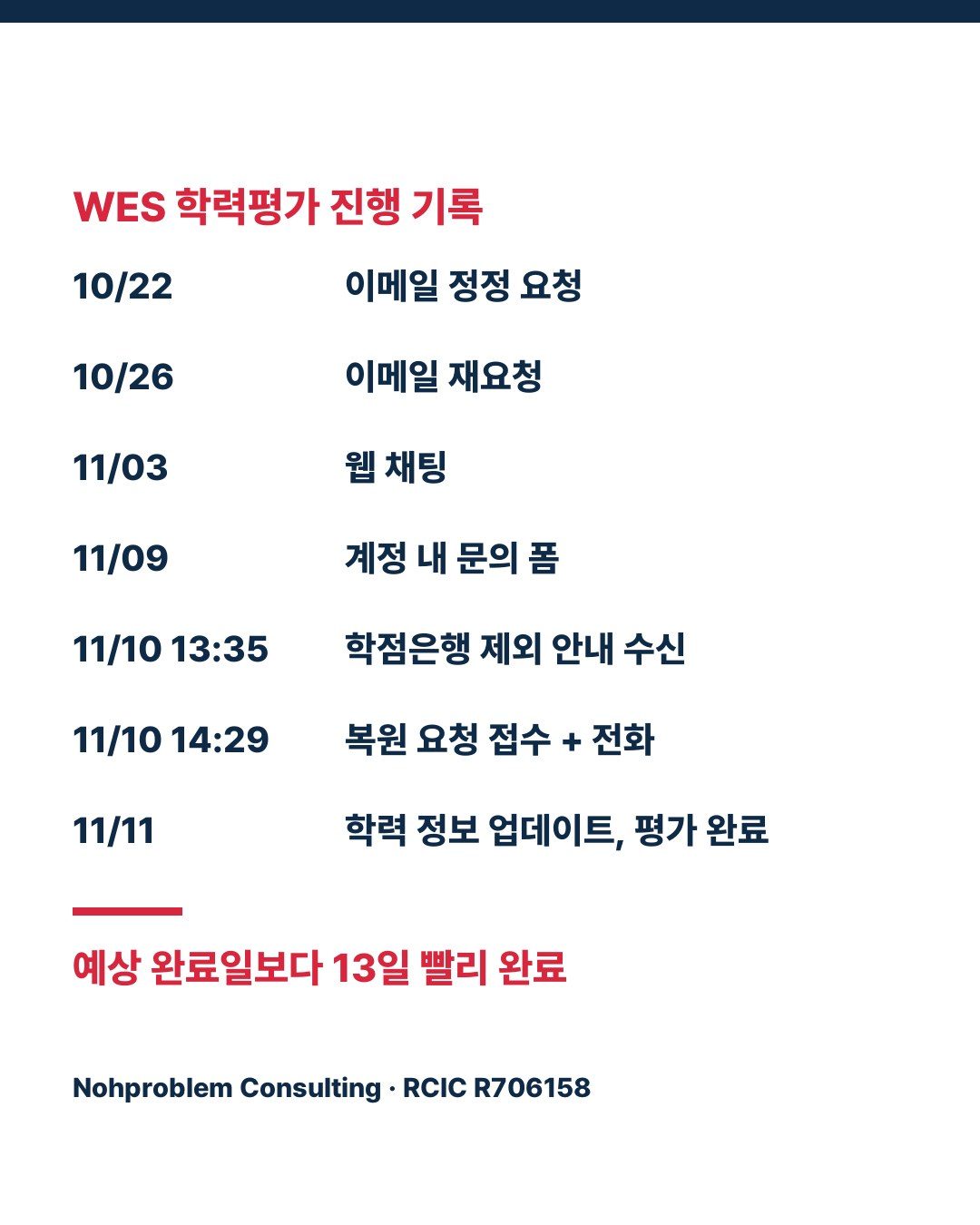
Five contacts, three channels. We first asked for a correction by email on October 22. The reply said the request had been forwarded to the relevant department. On October 26 we emailed again, and on November 3 we tried to connect directly through web chat, but were directed back to the inquiry form. On November 9 we used the inquiry form inside the account to make a formal request, laying out the history and the supporting points. We used all three channels, email, chat and the inquiry form, and kept every inquiry number and reply organized by date.
Second obstacle: a notice that the credit bank entry was removed from the evaluation. On November 10 at 1:35 p.m., WES advised that the credit bank entry would be excluded from the evaluation and only the junior college degree would be evaluated. These courses are central to ECE certification, so leaving it that way could have hurt the level decision. About an hour later, at 2:29 p.m., we filed a restoration request. Item by item, it asked that the credit bank be kept as an in progress program with no degree awarded, that only the degree certificate requirement be removed, and that every course on the transcript be evaluated course by course. The same day we also arranged a separate confirmation by phone.
And the next day: on November 11, WES replied that it had reviewed and updated the recorded education information and that the evaluation had entered its final stage. At 9:26 a.m. the same day, the evaluation completion email arrived. This result came 20 days after the first correction request, at the end of five contacts. With this report, the file now moves on to the ECE certification application stage.
In numbers: at least 5 contacts (2 emails, 1 chat, 2 inquiry forms) plus a phone call, about 1 hour from the exclusion notice to the restoration request, and completion 13 days ahead of the estimated date.
If you do it yourself, know these five things before you start. 1. Enter a credit bank program with no degree as an in progress transcript, not as "completed". If it goes in as completed, a degree certificate requirement tends to be attached and the evaluation stalls. 2. When you write an inquiry, state item by item what should stay and what alone should be removed. If the wording is broad, the education entry itself may be removed rather than the document requirement. 3. Email and chat often bring repeated standard replies. Use the inquiry form inside the account and the phone together. Phone hours follow Eastern Time, so from Vancouver they end at 4 p.m. 4. The inquiry form button may not work on the first click. Before clicking again, check whether a submission confirmation email has arrived, so you do not file a duplicate. 5. The account locks after three wrong login attempts. Managing your password is managing your timeline.
What to take away: a credential evaluation looks like sending documents and waiting, but when education with no degree is mixed in, the direction can change partway through. Noticing it right away, organizing the supporting points and pursuing it through several channels to the end is what protects the result. ECE certification and WES credential evaluation, Nohproblem is with you from start to finish. Kakao channel: https://pf.kakao.com/_ZngMC
What this approval means
To work as an early childhood educator (ECE) in Canada you first need recognition from the province where you will work. Standards differ by province; Saskatchewan assigns Level I, II or III based on the courses and credits completed, and foreign education usually goes through a course by course credential evaluation.
What we checked
- Each transcript course compared with the provincial subject areas
- Whether practicum courses are included and which areas are short
- Matching names, school names and dates across the forms and the evaluation
Where people often get stuck when applying on their own
- Course titles that do not map cleanly to the subject areas
- Entering the degree status wrongly on the evaluation application and being asked for documents again
- Treating certification as if it were work authorization
More detail: ECE services, Korean ECE conversion guide.